Most of our pupils take their practical test in the Vogue tuition car, but some learners would rather sit it in their own car. That’s allowed, but the rules are strict and examiners do check. The DVSA says it has seen an increase in people attending their tests in vehicles that aren’t roadworthy, and a cancelled test means paying for another slot and waiting for a new date.
This guide covers exactly what your car needs for a driving test in 2026, the cars that can’t be used, and a simple checklist to run through before test day. If you’re booked in for the Worthing driving test, which is where all Vogue pupils take their tests, it applies to you too.
What Are the Rules for Using Your Own Car for a Driving Test?
Your car must meet all of the following. Miss one and the test can be cancelled.
| Requirement | What to check |
|---|---|
| Tax | The car is taxed. |
| Insurance | The car is insured for a driving test. Check with your insurer, as a normal learner policy may not cover it. |
| MOT and roadworthiness | The car is roadworthy and has a current MOT if it is more than 3 years old. |
| Warning lights | No warning lights showing safety issues, for example the airbag warning light. |
| Tyres | No tyre damage and legal tread depth on every tyre. A space-saver spare tyre must not be fitted. |
| Examiner’s mirror | An extra interior rear-view mirror for the examiner. |
| Passenger seat | A passenger seatbelt and head restraint for the examiner. Slip-on types are not allowed. |
| Speed and speedometer | Able to reach at least 62mph, with an officially fitted mph speedometer (not just an extra display or a phone app). |
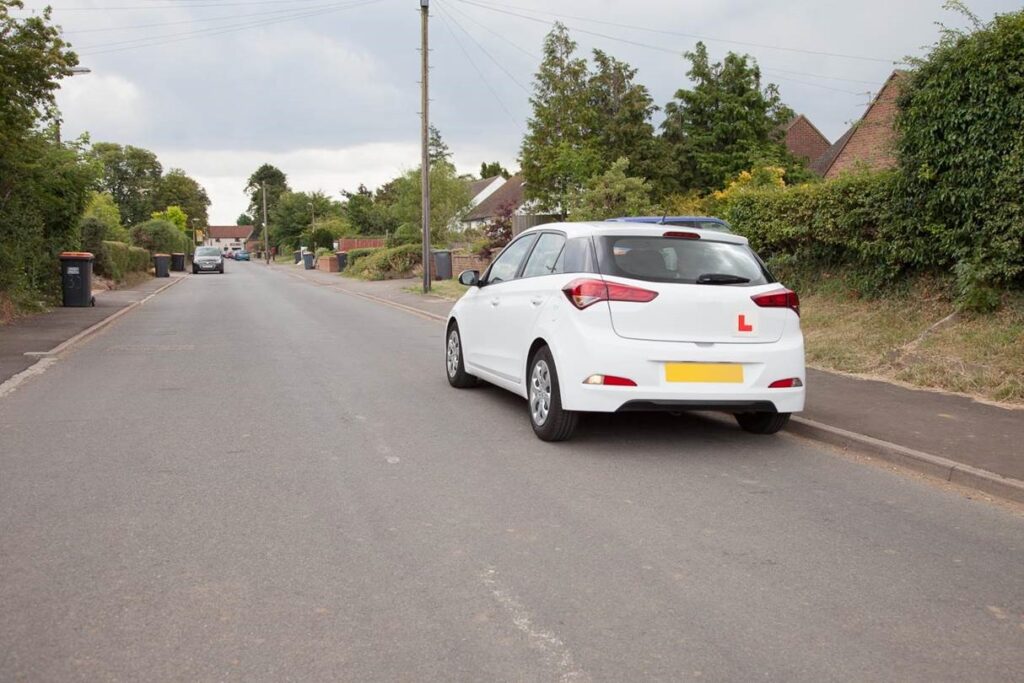
| L-plates | L-plates on the front and rear (L or D plates in Wales). |
| Size | 4 wheels and a maximum authorised mass of no more than 3,500kg. The figure is in the car’s handbook. |
Other Things That Can Get Your Driving Test Cancelled
Beyond the main rules, the DVSA also expects the following:
- A clean, tidy car. Clear rubbish and unnecessary items from the dashboard, footwells, door pockets, cup holders and seats.
- A smoke-free car. No smoking in the car just before or during the test.
- Dashcams that face outwards only. An insurance camera is fine if it doesn’t film inside the car or record audio from inside the car.
- Legal window tints. The windscreen and front side windows must follow the rules for tinted windows. There are no rules for rear windows, but your test may be cancelled if they’re too dark for the examiner to see clearly.
- A convertible roof that stays up. If you use a convertible, the roof must stay up for the whole test.
Which Car Features Can You Use on a Driving Test?
Driver aids are fine in most cases, but a few can’t be used during the test.
- Allowed: electronic parking brake, hill-start assist, cruise control, speed limiters, parking sensors and cameras, lane assist, blind spot monitoring and traffic sign recognition.
- Not allowed during the test: self-parking, Tesla autopilot, and your own sat nav. The examiner gives the independent driving instructions.
Cars You Can’t Use for a Driving Test
Examiners need all-round vision, so some cars aren’t accepted. According to GOV.UK, you can’t use:
- Any panel van, meaning a car without rear seats or rear side windows.
- BMW 218 convertible, BMW Mini convertible, Ford KA convertible, Polestar 4, Polestar 5, Smart Fortwo (2-door), Toyota iQ and VW Beetle convertible.
The list isn’t exhaustive, so other models may also be refused. If your car is a coupe (fixed roof, two doors and a sloping rear) or a convertible, check before test day. If you’ve booked, use your booking confirmation to contact the test centre. If you haven’t booked yet, contact the DVSA.
Cars with known safety recalls
Some cars with a known airbag recall can only be used if you bring proof that they’re safe. GOV.UK currently lists certain Citroën C3, C4, DS3, DS4 and DS5 models and some DS Automobiles DS3 models built between 2009 and 2019. Without the right proof, your test will be cancelled and you could lose your fee. Check the GOV.UK page for the current list and the proof you need, as it can change.
Manual or Automatic: Which Car Can You Take Your Test In?
You can take your test in a manual (3 pedals) or an automatic or semi-automatic (2 pedals). The licence you get depends on the car: pass in a manual and you can drive both manual and automatic cars, but pass in an automatic and you can only drive automatics. That’s why Vogue Driving School teaches manual only, so you leave with a full licence. See our manual driving lesson prices.
Your Pre-Test Car Checklist
Don’t leave this to test morning. A week before, run through this list:
- Tax and MOT are in date and won’t expire before your test.
- You’ve phoned your insurer and confirmed you’re covered for the driving test.
- Start the engine and make sure no warning lights stay on.
- Check every tyre for damage and tread depth, and take out any space-saver spare.
- The examiner’s interior mirror is fitted, secure and clear to use.
- The passenger seatbelt and a proper (non slip-on) head restraint are in place.
- L-plates are fitted at the front and the rear.
- The car is clean, tidy and smoke-free, and any dashcam faces outwards.
- You’ve checked the car isn’t on the list of cars that can’t be used, or a recalled model.
For more on getting everything ready, read our guide to preparing for your practical driving test, and remember that you must book your test yourself on GOV.UK under the 2026 booking rules.
Own Car or the Vogue Tuition Car for Your Test?
Whichever you choose, it should be a car you’re completely comfortable in. If you test in your own car, get plenty of practice in it first, because the controls, visibility and clutch bite point can feel different from the car you learned in.
Many of our pupils prefer our tuition car. It’s already set up for test day, you’ve driven it throughout your lessons, and we take you out for a warm-up drive before your test at Worthing Driving Test Centre (Field Place, The Boulevard, Worthing, BN13 1NP). We cover Brighton, Hove, Portslade, Southwick and Shoreham. Talk to Guy about what suits you best before you book your test.
Pass First Time with Vogue Driving School
Passing your test is hard enough without a car problem on the day. With over 25 years of teaching experience, our Grade A Approved Driving Instructor, Guy, will get you test-ready in every way, from the Worthing test routes to a car you’re confident in.
Ready to get started? See our manual driving lesson prices and discounted blocks, read our pupil reviews, or contact Vogue Driving School to check coverage for your postcode.
Source: GOV.UK: Using your own car for your driving test. Rules can change, so always check the official page before test day.